 |
GELOSO G210 TR
Italy - 1952 |
 |
|
|
GELOSO G210 TR
Italy - 1952 |
|
 English
 |
 |
Italiano
 |
 Click on
the image to enlarge Click on
the image to enlarge
 Clicca sull'immagine per
ingrandire Clicca sull'immagine per
ingrandire
|
||
|
Geloso
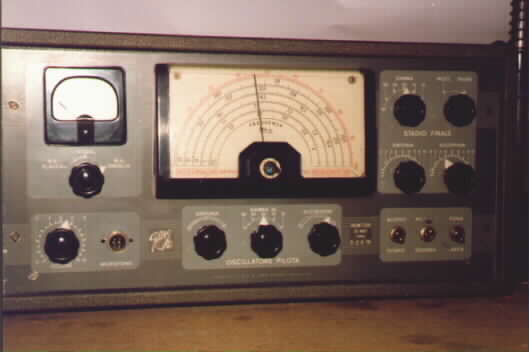
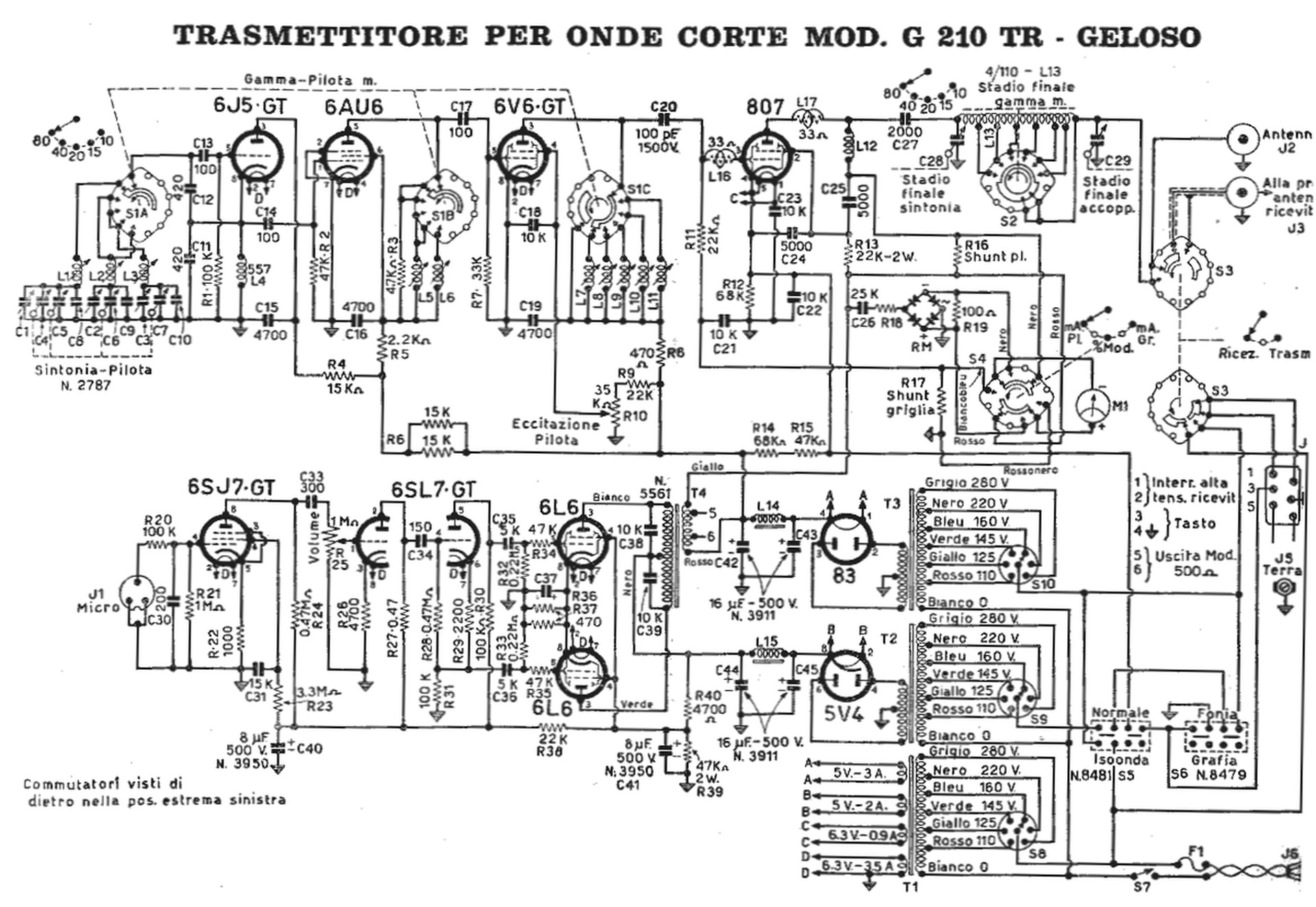
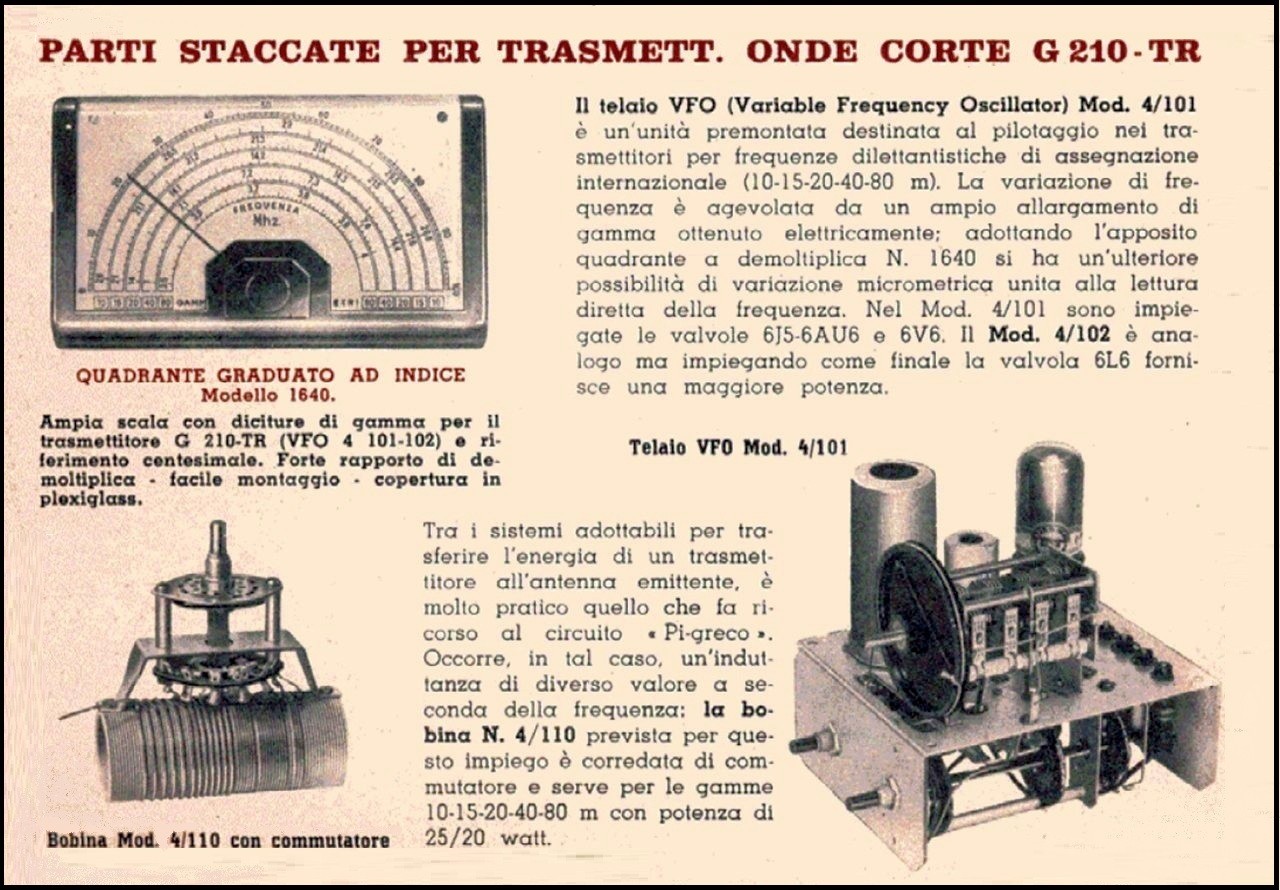
mod. G210 TR - Geloso S.A. - Viale Brenta, 29 Milano Italia - Italy 1952. Trasmettitore radio appositamente progettato per uso amatoriale, la potenza di uscita è di 25 W in AM e CW, con modulazione AM al 100% (il modulatore ha due valvole 6L6G in push-pull). In CW il G210 trasmette con la manipolazione catodica dell'amplificatrice finale a RF (un tetrodo a fascio 807). Il VFO adottato è del tipo "Clapp" (mod. 4/101), che permette un'eccellente stabilità in frequenza, ha circuito separatore a larga banda e un circuito driver. Lo stadio amplificatore di potenza a RF è potenziato da un tubo a fascio 807 e da un filtro a P-greco (mod. 4/110) che permette una vasta gamma di accordo su varie impedenze d'antenna. Il G-210 trasmette su cinque bande amatoriali: 10 - 15 - 20 - 40 e 80 metri. Le valvole utilizzate sono dieci: sezione RF: 6J5, 6AU6, 6V6GT, 807, 83; sezione audio 6SJ7, 6SL7, 6L6G, 6L6G, 5V4G. Il microfono da collegare al trasmettitore è piezoelettrico, ad esempio il modello Geloso M-40 da palmo o il B 80/1100 da tavolo. Il mobile del trasmettitore è in ferro smaltato a forma di parallelepipedo e ha dimensioni: 52 x 25 x 26 cm, il peso dell'apparato è di 20 kg. Acquistai il G210 da un anziano radioamatore nel 1968 che me lo vendette per poche lire perché non lo utilizzava da molto in quanto usava un apparato più moderno (con SSB) e la valvola 807 del finale RF del Geloso era esaurita. La 807 io ce l'avevo, era quella che mi aveva regalato I1TI sette anni prima e che avevo utilizzato con successo per costruire il mio primo trasmettitore. Sostituita la valvola il G210 funzionò perfettamente e in abbinamento al ricevitore Magnadyne SV45 modificato che a quel tempo stavo usando mi permise di fare parecchi collegamenti in AM sui 40 metri e anche sui 27 MHz, banda che da poco era divenuta popolare e che riuscivo a ricevere con la Magnadyne SV45 sulla quale avevo smanettato le bobine della gamma Onde Corte 1. IK3HIA © 2004-2025. |
||
 |
 |
 |
|
Geloso mod. G210 TR - Geloso S.A. - Viale Brenta, 29 Milano Italia -
Italy 1952. Radio transmitter specially designed for amateur use, the output power is 25 W in AM and CW, with 100% AM modulation (the modulator has two 6L6G valves in push-pull). In CW the G210 transmits with the cathode keying of the final RF amplifier (an 807 beam tetrode). The VFO adopted is of the "Clapp" type (mod. 4/101), which allows excellent frequency stability, has a wide band separator circuit and a driver circuit. The RF power amplifier stage is enhanced by an 807 beam tube and a P-greek filter (mod. 4/110) which allows a wide range of tuning on various antenna impedances. The G210 transmits on five amateur bands: 10 - 15 - 20 - 40 and 80 meters. Ten valves are used: RF section: 6J5, 6AU6, 6V6GT, 807, 83; audio section 6SJ7, 6SL7, 6L6G, 6L6G, 5V4G. The microphone to connect to the transmitter is piezoelectric, for example the Geloso M-40 palm model or the B 80/1100 table model. The transmitter cabinet is made of enameled iron in the shape of a parallelepiped and has dimensions: 20.3 x 10 x 10.2 inch, the weight of the device is 44 lb 0.8 oz. I bought the G210 from an elderly radio amateur in 1968, who sold it to me for few italian lire because he hadn't used it for long, having used a more modern rig (with SSB) and the 807 tube in the Geloso's RF amplifier was worn out. I had the 807; it was the one I1TI had given me seven years earlier and which I had successfully used to build my first transmitter. After replacing the tube, the G210 worked perfectly, and in combination with the modified Magnadyne SV45 receiver I was using at the time, it allowed me to make numerous AM contacts on 40 meters and also on 27 MHz, a band that had recently become popular and which I was able to receive with the Magnadyne SV45 on which I had tinkered with the shortwave 1 band coils. IK3HIA © 2004-2025. |
||
|
Back to the top of the page
Torna all'inizio della pagina |
||
| Return to: ik3hia home page |
 |
|
Return to: Old Ham Radios |