 |
Wireless Set R109 Communications
Receiver UK - 1940 |
 |
|
Wireless Set R109 Communications
Receiver UK - 1940 |
|
|
|
 |
Italiano
 |
|
Wireless Set
R109 Communications Receiver -
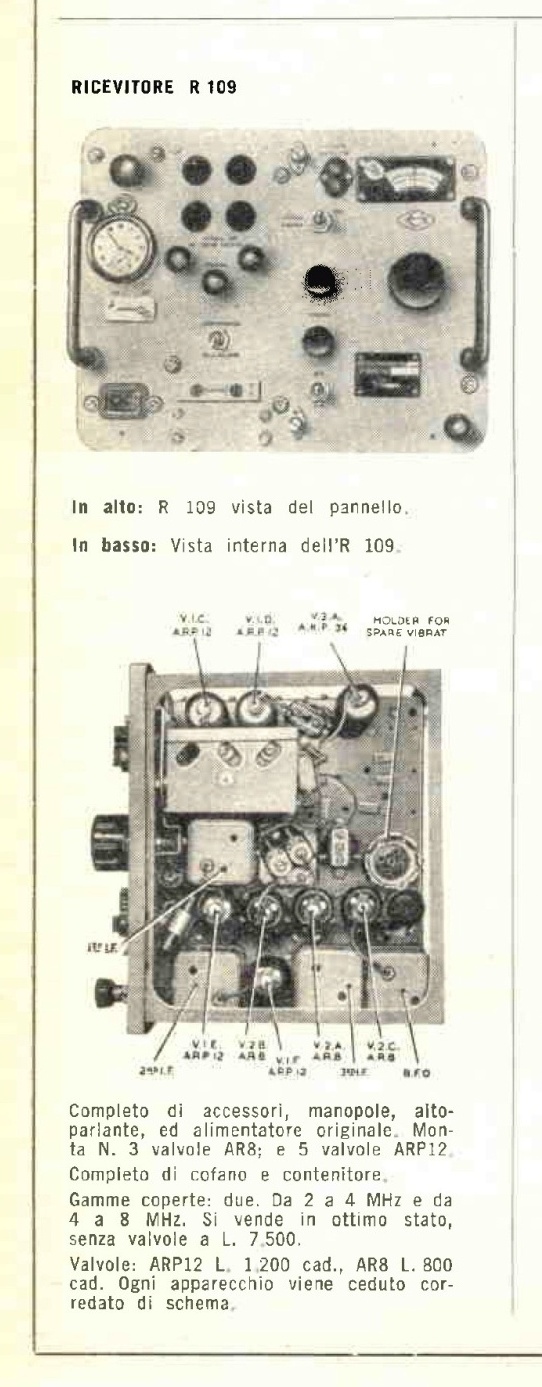
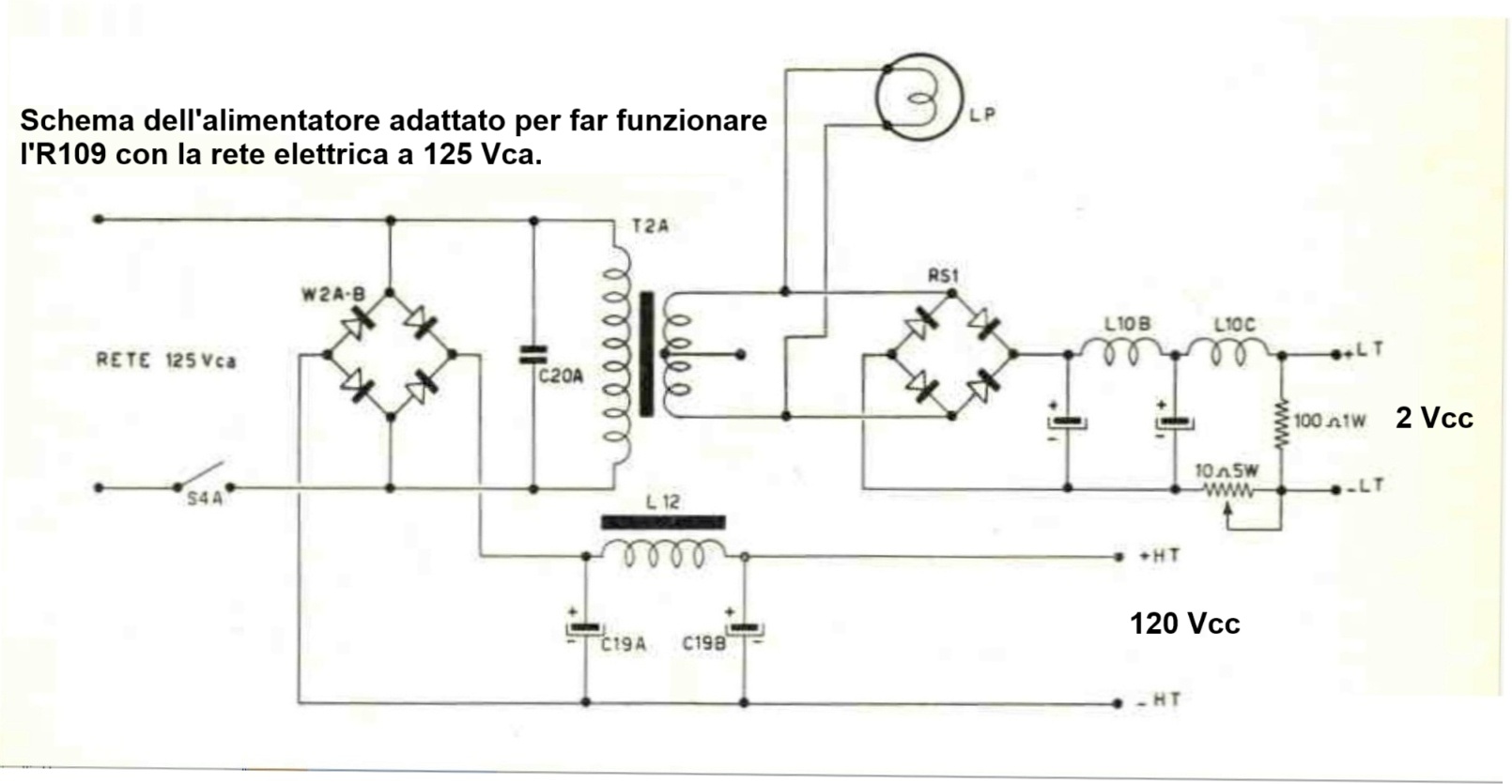
Inghilterra 1940. L'R109 è un ricevitore utilizzato su veicoli e in stazione fissa dall'esercito inglese durante la II Guerra Mondiale. La copertura di frequenza è da 1,8 a 9 MHz suddivisa in due gamme: la prima da 1,8 a 3,9 MHz e la seconda da 3,9 a 8,5 MHz. le modalità di ricezione sono AM e CW (telegrafia non modulata). Questo ricevitore ha avuto tre versioni successive: l'R-109A, l'R109B e l'R109C che differiscono dal 109 per alcune minime differenze sulla copertura in frequenza e per le valvole utilizzate. Il circuito è una supereterodina con singola conversione a 465 kHz. Le valvole utilizzate sono tutte con zoccolo octal tipo Mazda, con filamento a 2 Vcc e riscaldamento diretto: cinque sono delle ARP12 e tre sono delle AR8. L'alimentazione originale è a batteria tipo autoveicolo da 6 volt con un survoltore a multivibratore per realizzare la tensione anodica. L'ascolto avviene tramite altoparlante (escludibile) o con le cuffie. Questo ricevitore inglese fu utilizzato fino al 1960 anche dal ricostituito esercito italiano al quale, nel 1946, erano state cedute forti aliquote di attrezzature radio e telefoniche smesse dagli alleati dopo la Seconda Guerra Mondiale. Successivamente tali apparecchiature furono dismesse anche dagli italiani e a partire dal 1961, sul mercato del surplus assieme al resto apparvero anche moltissimi esemplari dell'R109. Visto il basso prezzo queste radio furono acquistate da molti squattrinati radiantisti (come me) che in tal modo poterono entrare in possesso di un discreto ricevitore che, dopo la modifica all'alimentazione, poteva coprire le bande radioamatoriali degli 80 e dei 40 metri, con ricezione di segnali in AM e in CW (e con un po' di pazienza anche in SSB) grazie al B.F.O. IK3HIA © 2004. |
||
 |
 |
 |
 Wireless Set R109 Communications Receiver - England, 1940.
The R109 is a receiver used on vehicles and at fixed stations by the British Army during World War II. Its frequency coverage is from 1.8 to 9 MHz, divided into two bands: the first from 1.8 to 3.9 MHz and the second from 3.9 to 8.5 MHz. The reception modes are AM and CW (unmodulated telegraphy). This receiver had three subsequent versions: the R-109A, the R109B and the R109C which differ from the 109 for some minor differences in frequency coverage and in the tubes used. The circuit is a superheterodyne with a single conversion at 465 kHz. The tubes used are all Mazda-type octal sockets, with 2 VDC filaments and direct heating: five are ARP12s and three are AR8s. The original power supply is a 6-volt automotive battery with a multivibrator booster to generate the anode voltage. Listening is done through a speaker (which can be switched off) or headphones. This British receiver was also used until 1960 by the reconstituted Italian army, which, in 1946, had received a large portion of radio and telephone equipment discarded by the Allies after World War II. Subsequently, this equipment was also decommissioned by the Italians, and starting in 1961, numerous examples of the R109 appeared on the surplus market, along with other equipment. Given the low price, these radios were purchased by many penniless radio operators (like me) who were thus able to get hold of a decent receiver which, after modifying the power supply, could cover the 80 and 40 meter amateur radio bands, with reception of signals in AM and CW (and with a little patience also in SSB) thanks to the B.F.O. IK3HIA © 2004. |
||
Back to the top of the page  Torna all'inizio della pagina
 |
||
| Return to: ik3hia home page |
 |
Return to: military surplus page 1 |